3477 & 358, Plot No. 357, Jayadev Vihar-Ekamra Kanana Rd, Jayadev Vihar, Bhubaneswar, Odisha 751013
best-ivf-centre-bhubaneswar
Best IVF Centre in Bhubaneswar
This has strong local SEO intent and matches what prospective patients are likely to search.
Choose only one of these as the focus keyword:
- IVF Centre in Bhubaneswar
- IVF Treatment in Bhubaneswar
- Fertility Centre in Bhubaneswar
- Best Fertility Clinic in Bhubaneswar
- IVF Hospital in Bhubaneswar
Services
- IVF Specialist in Bhubaneswar
- Fertility Doctor in Bhubaneswar
- Infertility Treatment in Bhubaneswar
- Male Infertility Treatment
- Female Infertility Treatment
- ICSI Treatment
- IUI Treatment
- Egg Freezing
- Embryo Freezing
- Fertility Preservation
- Advanced IVF Treatment
- IVF Success Rate
- Reproductive Medicine
- Assisted Reproductive Technology (ART)
- PCOS Infertility Treatment
- Endometriosis Treatment
- Best IVF Clinic in Odisha
- IVF Centre in Odisha
- Fertility Clinic Odisha
- Affordable IVF Treatment
Best IVF Centre in Bhubaneswar | Advanced Fertility Treatment | Femelife IVF
Looking for the best IVF centre in Bhubaneswar? Femelife IVF offers advanced IVF, ICSI, IUI, fertility preservation, and personalized infertility treatment with experienced specialists.
FAQs About IVF in Bhubaneswar
1. Which is the best IVF centre in Bhubaneswar?
The best IVF centre is one that offers experienced fertility specialists, advanced embryology laboratories, personalized treatment plans, ethical practices, and comprehensive fertility services. Femelife provides IVF, ICSI, fertility preservation, and patient-centered infertility care in Bhubaneswar.
2. What is the cost of IVF treatment in Bhubaneswar?
The cost varies depending on medications, investigations, laboratory procedures, embryo freezing, and additional treatments such as ICSI or PGT. A personalized consultation provides the most accurate estimate.
3. How successful is IVF treatment in Bhubaneswar?
IVF success depends on factors such as female age, ovarian reserve, sperm quality, embryo quality, and the underlying cause of infertility. Younger women generally have higher pregnancy rates.
4. Who should consider IVF treatment?
IVF may be recommended for couples with:
- Blocked fallopian tubes
- Male infertility
- PCOS
- Endometriosis
- Low ovarian reserve
- Unexplained infertility
- Recurrent IVF or IUI failure
5. How long does an IVF cycle take?
A typical IVF cycle takes approximately 4–6 weeks, including ovarian stimulation, egg retrieval, fertilization, embryo culture, embryo transfer, and pregnancy testing.
6. Is IVF painful?
Most IVF procedures involve minimal discomfort. Egg retrieval is performed under anesthesia or sedation, while embryo transfer is usually painless.
7. What tests are performed before IVF?
Your fertility specialist may recommend:
- AMH test
- Hormonal profile
- Pelvic ultrasound
- Semen analysis
- Infectious disease screening
- Uterine cavity assessment
8. What is ICSI, and when is it needed?
ICSI (Intracytoplasmic Sperm Injection) involves injecting a single sperm directly into an egg. It is commonly recommended for severe male infertility or previous fertilization failure.
9. Can IVF help with male infertility?
Yes. IVF combined with ICSI can successfully treat many cases of low sperm count, poor sperm motility, abnormal sperm morphology, or surgically retrieved sperm.
10. Can women with PCOS undergo IVF?
Yes. IVF is an effective option for women with PCOS who have not conceived with lifestyle modification, medications, or IUI.
11. Is IVF safe?
Yes. IVF is a well-established and safe fertility treatment when performed by experienced fertility specialists using evidence-based protocols.
12. Can frozen embryos be used later?
Yes. High-quality embryos can be cryopreserved and transferred in a future frozen embryo transfer (FET) cycle.
13. What is fertility preservation?
Fertility preservation involves freezing eggs, sperm, or embryos for future pregnancy, especially before cancer treatment or delayed childbearing.
14. How many embryos are transferred during IVF?
The number depends on the woman’s age, embryo quality, previous IVF history, and clinical guidelines. Single embryo transfer is often preferred to reduce the risk of twins.
15. Can IVF guarantee pregnancy?
No. Although IVF significantly improves the chances of conception, no fertility treatment can guarantee pregnancy.
16. When should I consult an IVF specialist in Bhubaneswar?
You should consult a fertility specialist if:
- You are under 35 and have not conceived after one year of regular unprotected intercourse.
- You are over 35 and have not conceived after six months.
- You have known fertility problems such as PCOS, endometriosis, or male infertility.
17. Does Femelife IVF Bhubaneswar offer ICSI and fertility preservation?
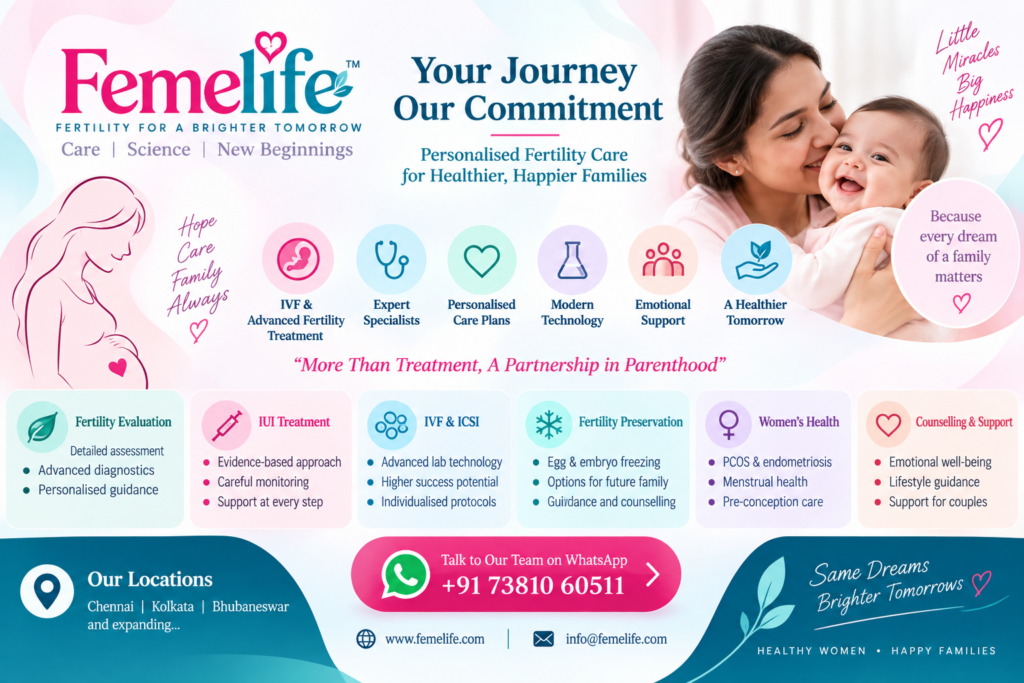
Yes. Femelife offers IVF, ICSI, embryo freezing, egg freezing, fertility preservation, and other assisted reproductive treatments.
18. Where is Femelife IVF located in Bhubaneswar?
Femelife is located near Ekamra Park, Jayadev Vihar, Bhubaneswar, making it easily accessible for patients across Odisha.
19. What services are available at Femelife IVF Bhubaneswar?
The centre offers:
- Fertility evaluation
- IVF
- ICSI
- IUI
- Egg freezing
- Embryo freezing
- Male infertility treatment
- Fertility preservation
- Preimplantation Genetic Testing (PGT)
- Fertility counselling
20. Why should I choose Femelife IVF in Bhubaneswar?
Femelife IVF combines experienced fertility specialists, advanced embryology laboratories, individualized treatment plans, ethical fertility care, and comprehensive reproductive services under one roof. The centre focuses on evidence-based treatment and compassionate patient support throughout the fertility journey.
best-ivf-centre-bhubaneswar
Frequently Asked Questions (FAQs) About IVF (In Vitro Fertilization)
1. What is IVF (In Vitro Fertilization)?
IVF is an advanced fertility treatment in which eggs are retrieved from the ovaries, fertilized with sperm in a laboratory, and the resulting embryo is transferred into the uterus to achieve pregnancy.
2. Who needs IVF treatment?
IVF is recommended for couples facing infertility due to blocked fallopian tubes, severe male infertility, ovulation disorders, endometriosis, unexplained infertility, low ovarian reserve, or repeated failure of simpler fertility treatments.
3. What is the success rate of IVF?
IVF success depends on several factors including female age, embryo quality, sperm quality, uterine health, and the underlying cause of infertility. Younger women generally have higher success rates.
4. At what age is IVF most successful?
Women under 35 years usually have the highest IVF success rates because of better egg quality and ovarian reserve.
5. How long does an IVF cycle take?
A complete IVF cycle generally takes about 4–6 weeks from ovarian stimulation to pregnancy testing.
6. Is IVF painful?
Most IVF procedures involve minimal discomfort. Egg retrieval is performed under anesthesia or sedation, and embryo transfer is usually painless.
7. What tests are required before IVF?
Common tests include hormone evaluation, ovarian reserve assessment (AMH), ultrasound, semen analysis, infectious disease screening, and uterine cavity assessment.
8. How many eggs are needed for successful IVF?
The number varies, but retrieving multiple mature eggs increases the chances of obtaining healthy embryos.
9. What is ICSI, and how is it different from IVF?
ICSI (Intracytoplasmic Sperm Injection) involves injecting a single sperm directly into an egg and is commonly used in severe male infertility.
10. Can IVF help male infertility?
Yes. IVF combined with ICSI can successfully treat many cases of male infertility, including low sperm count, poor motility, and abnormal sperm morphology.
11. What is embryo transfer?
Embryo transfer is the process of placing one or more embryos into the uterus using a thin catheter. It is a simple outpatient procedure.
12. How many embryos are transferred during IVF?
The number depends on the woman’s age, embryo quality, and medical guidelines. Single embryo transfer is often recommended to reduce the risk of multiple pregnancies.
13. What is blastocyst transfer?
A blastocyst is a five- to six-day-old embryo. Blastocyst transfer may improve implantation rates in selected patients.
14. What is embryo freezing?
Embryo freezing (cryopreservation) allows good-quality embryos to be stored for future use using advanced vitrification techniques.
15. Can frozen embryos result in a healthy pregnancy?
Yes. Frozen embryo transfer (FET) has excellent success rates, and many healthy babies are born from frozen embryos.
16. What is egg freezing?
Egg freezing preserves a woman’s eggs for future pregnancy, making it a valuable option for women delaying childbirth or undergoing treatments that may affect fertility.
17. What is fertility preservation?
Fertility preservation includes freezing eggs, sperm, or embryos before medical treatments or age-related fertility decline.
18. Can women with PCOS undergo IVF?
Yes. IVF is an effective treatment for women with Polycystic Ovary Syndrome (PCOS), especially when other fertility treatments have not been successful.
19. Can endometriosis affect IVF success?
Endometriosis may reduce fertility, but IVF remains one of the most effective treatment options for many women with this condition.
20. What lifestyle changes improve IVF success?
Maintaining a healthy weight, eating a balanced diet, exercising regularly, avoiding smoking and excessive alcohol, reducing stress, and getting adequate sleep may improve fertility outcomes.
21. Is IVF safe?
IVF is considered a safe and well-established fertility treatment. Most complications are uncommon and can usually be managed with appropriate medical care.
22. What is ovarian stimulation?
Ovarian stimulation uses fertility medications to encourage the development of multiple mature eggs during an IVF cycle.
23. What happens if IVF fails?
If IVF is unsuccessful, your fertility specialist will review the cycle, identify possible reasons, and recommend modifications or alternative treatment options for future attempts.
24. Can IVF guarantee pregnancy?
No. While IVF significantly improves the chances of pregnancy, no fertility treatment can guarantee success.
25. Are twins common with IVF?
The risk of twins depends on the number of embryos transferred. Single embryo transfer has greatly reduced the likelihood of multiple pregnancies.
26. What is Preimplantation Genetic Testing (PGT)?
PGT is a laboratory technique used to screen embryos for certain genetic or chromosomal abnormalities before embryo transfer in selected cases.
27. When should I consult a fertility specialist?
Couples should seek evaluation after one year of regular unprotected intercourse without pregnancy, or after six months if the woman is over 35 years of age.
28. Can IVF be performed after previous failed fertility treatments?
Yes. Many couples undergo IVF after unsuccessful attempts with ovulation induction, IUI, or other fertility treatments.
29. How should I prepare for IVF?
Preparation includes completing recommended investigations, following prescribed medications, maintaining a healthy lifestyle, managing stress, and attending all scheduled appointments.
30. Why choose Femelife IVF for fertility treatment in Bhubaneswar?
Femelife IVF Bhubaneswar offers comprehensive fertility evaluation, advanced IVF and ICSI, experienced fertility specialists, modern embryology laboratories, personalized treatment plans, ethical practices, and compassionate care to support couples throughout their journey to parenthood.